
Blog · 2026-10-28
The Fed Held Rates. Here's What the 10-Year Treasury Means for Rhode Island Buyers and Sellers
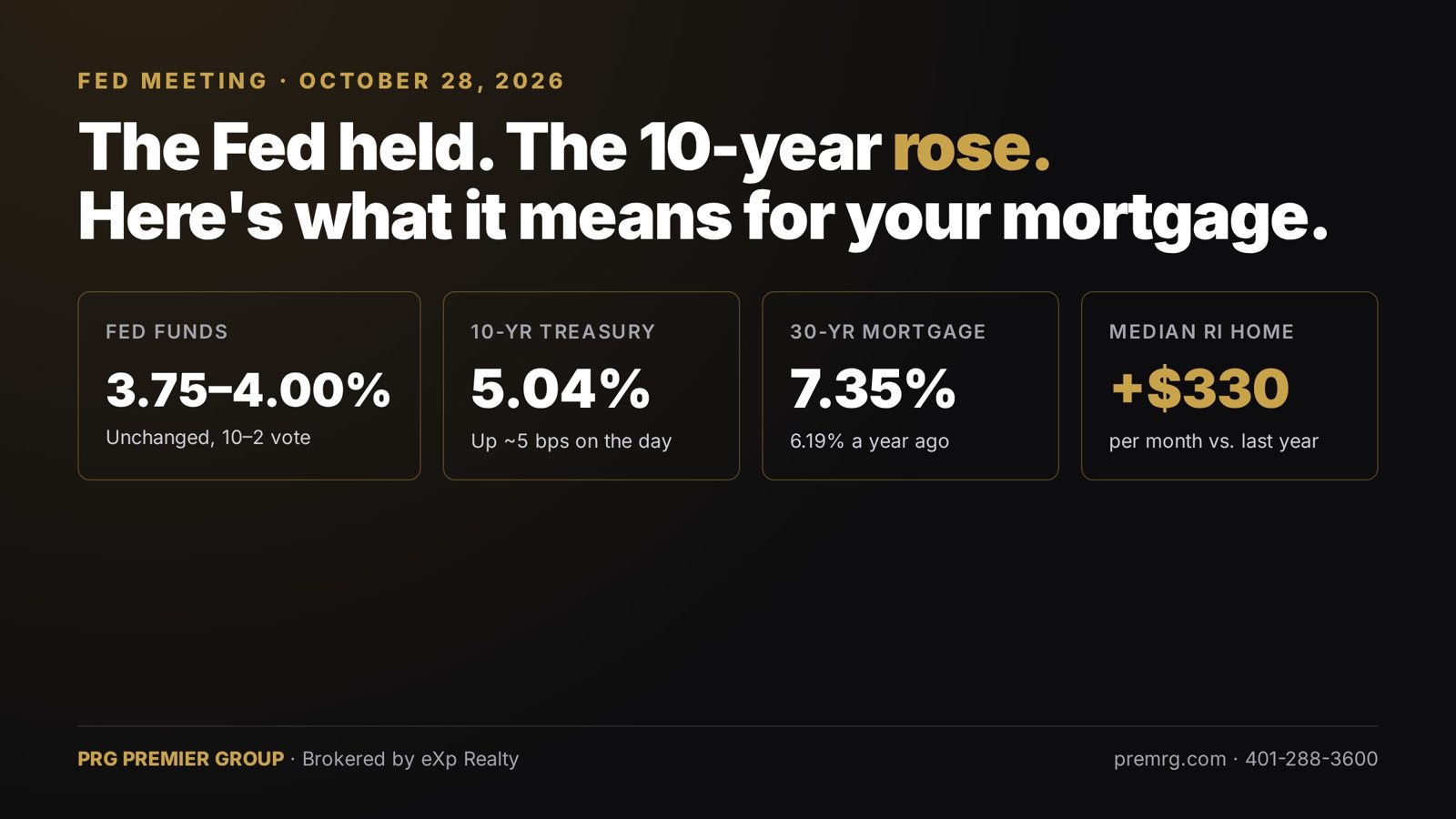
The Federal Reserve wrapped up its October meeting today and left its benchmark rate where it is: a target range of 3.75% to 4.00%. That's the range the Fed set on September 16, when it raised rates for the first time since 2023. The vote was 10 to 2, and the two dissenters, Governor Lisa Cook and Cleveland Fed President Beth Hammack, didn't want a cut. They wanted another quarter-point increase.
If you're buying or selling a home in Rhode Island, the headline "Fed holds rates" can sound like nothing changed. But what happened in the bond market this afternoon matters more for your mortgage rate than the Fed's decision itself. Here's what I'm watching and what it means for you.
What the Fed actually said
The statement was short and direct. The economy is "expanding at a strong pace," job gains have kept up with the workforce, and "inflation remains elevated." The Committee said it wants "the accumulation of more information" before deciding its next step, and closed with: "The Committee will deliver price stability."
Chairman Kevin Warsh made it clear in his press conference that the Fed is waiting, not finished. Heading into the meeting, futures markets were pricing a strong chance of another quarter-point hike at the next meeting on December 9. Nobody serious is talking about rate cuts right now.
The Fed doesn't set your mortgage rate. The 10-year Treasury does.
This is the part most people get wrong. The federal funds rate is an overnight rate banks charge each other. It moves credit cards, home equity lines and short-term loans almost immediately. A 30-year fixed mortgage is a different animal.
Most 30-year mortgages are paid off or refinanced within about seven to ten years, so investors who buy mortgage bonds price them off the 10-year U.S. Treasury yield. Lenders then add a spread on top for risk and costs. When the 10-year goes up, mortgage rates follow within days, usually hours. When it falls, mortgage rates fall. The Fed influences the 10-year, but it doesn't control it. Inflation expectations, government borrowing, oil prices and global events all push it around.
Today was a perfect example. After the announcement, the 2-year Treasury yield, which tracks the Fed closely, slipped to about 4.72%. The 10-year went the other way and closed around 5.04%, up roughly five basis points on the day. Bond investors heard "we'll wait" and decided long-term inflation risk hadn't gone away, especially with oil above $100 a barrel.
Where mortgage rates are right now
- Freddie Mac 30-year fixed: 7.32% for the week of October 22, down from 7.40% the week before. A year ago it was 6.19%.
- Mortgage News Daily daily index: 7.35% today, up slightly from 7.33% yesterday.
- The spread: with the 10-year near 5.04% and mortgages near 7.35%, the gap is about 2.3 percentage points. Historically it has run closer to 1.7. If that gap narrows, rates can improve even if the 10-year doesn't move.
Mortgage News Daily noted today's Fed announcement had essentially no impact on mortgage rates. The bond market had already moved.
What it means for buyers
Let's put real numbers on it. The Rhode Island single-family median was $534,000 in September. With 20% down, that's a $427,200 loan. At 6.19%, principal and interest runs about $2,614 a month. At today's 7.35%, it's about $2,943. That's roughly $330 more every month for the same house, before taxes and insurance.
Looking at it the other way, the payment that bought a $427,200 loan a year ago buys about $379,000 today. That's why some buyers have stepped back, and why mortgage purchase applications are still 18% below a year ago according to the Mortgage Bankers Association.
My advice to buyers:
- Watch the 10-year, not the Fed headlines. When it dips, call your lender that day. Every half point is roughly $144 a month on that median-priced loan.
- Less competition is your leverage. Fewer buyers means more room to negotiate price, repairs and seller-paid closing costs. A seller credit toward a rate buydown can be worth more than a price cut.
- Be careful with ARMs. Adjustable-rate loans are now 11.3% of applications, the highest in over a year. They can work, but only if you understand exactly when and how much the rate can reset.
- Don't wait for a perfect rate. If rates do fall meaningfully, buyers who stepped back will come back all at once, and prices follow demand.
What it means for sellers
Rhode Island prices have held up because inventory is still tight, but September sales were down year over year. Higher rates shrink the pool of buyers who qualify at your price. The buyers who are out there are payment-sensitive and doing their homework.
- Price it right the first day. In a rate-sensitive market, overpriced homes sit, and buyers notice days on market. As a certified appraiser, I price from closed comps, not from what a website estimate says.
- Consider offering a rate buydown credit. A credit that lowers the buyer's rate can bring more qualified buyers to the table than an equal price reduction.
- Condition matters more. Buyers stretching on payment don't have extra cash for repairs. Move-in ready homes are still selling.
- Don't assume rates will rescue you. If the Fed hikes again in December, borrowing costs could rise from here, not fall.
Key takeaways
- The Fed held at 3.75%–4.00% today, with two members voting for another hike.
- Mortgage rates follow the 10-year Treasury, which rose to about 5.04% after the decision.
- The 30-year fixed is around 7.3%, more than a full point above last year.
- On a median Rhode Island home, that's about $330 a month more than a year ago.
- Buyers have negotiating leverage. Sellers need sharp pricing and smart concessions.
Every move is different, and the right strategy depends on your numbers, your town and your timeline. If you want to talk through what today's rates mean for you, call me at 401-288-3600 or get a free, appraiser-backed home value at premrg.com.
Sources: Federal Reserve FOMC statement and Chairman Warsh press conference, October 28, 2026; CNBC and InvestingLive Treasury closes, October 28, 2026; Freddie Mac PMMS, October 22, 2026; Mortgage News Daily, October 28, 2026; Mortgage Bankers Association weekly survey via CNBC, October 28, 2026; RI Association of Realtors / State-Wide MLS, September 2026. Payment estimates are principal and interest only on a 30-year fixed loan and are illustrative, not a loan quote. Information deemed reliable but not guaranteed. Equal Housing Opportunity.